In production · v1.2 · June 2026

Sovereignty
by Architecture.

Every other sovereign-cloud offering is a promise. SkyeConnex makes it mathematically impossible for any single cloud, country, or government to read, surrender, or destroy your data — even under court order.

Recognised by
BARC — operational reference, May 2026 · Standards Council of Canada — DGSI 100-8 · Gartner — briefed
14
Storage providers
7
Shards per file · RS(5,2)
400+
Production API endpoints
11
Privacy regimes supported
The thesis

Mathematics, not promises.

Trust models scale with relationships. Mathematical guarantees scale with files. We encode the sovereignty guarantee into the data itself — through three reinforcing layers that depend on no single party behaving honestly.

  1. L1

    Cryptographic isolation

    Per-file unique data-encryption keys, AES-256-GCM frame encryption, and ML-KEM-1024 hybrid post-quantum key wrap. The server never holds an unwrapped User Master Key.

  2. L2

    Geometric distribution

    Reed-Solomon RS(5,2) erasure coding splits every file into seven shards across the customer's chosen providers. Loss of any two leaves the file fully recoverable; compromise of any one reveals nothing.

  3. L3

    Jurisdictional policy

    Every provider connexion is region-tagged. Allow-list, block-list, and strict-mode enforcement runs at upload time — auditable, signed, exportable.

The compound effect
"An adversary attempting to read a single SkyeConnex file must simultaneously defeat the wrapped DEK, compel five providers across multiple jurisdictions, and complete both before the audit log surfaces the activity. There is no published successful attack against this composition."
CloudRAID

Multi-cloud RAID. Not multi-cloud sync.

Every file is encrypted client-side, framed into ~5 MB chunks, Reed-Solomon RS(5,2) encoded into seven shards, and scattered across the providers — and jurisdictions — you choose.

YOUR FILE document.pdf CLIENT-SIDE AES-256-GCM + ML-KEM-1024 ~5 MB frames ERASURE CODE Reed-Solomon RS(5,2) 5 data + 2 parity Shard 1 AWS S3 · ca-central-1 Shard 2 Azure · germanywestcentral Shard 3 Backblaze B2 · eu-central Shard 4 Wasabi · eu-west-1 Shard 5 OVH · gra · France Shard 6 (parity) Scaleway · par-1 Shard 7 (parity) MinIO · on-prem · CA

Compelled-disclosure resistant

A subpoena to any one provider yields nothing readable. A subpoena to any two yields nothing readable. Compelling five across multiple jurisdictions is operationally impossible.

Breach-resistant by topology

No single provider holds enough of any file to read it. There is no "the breach reads everything" failure mode — the data isn't in any one place to be read.

Residency you can prove

Every file knows which jurisdictions hold its shards. Per-file, per-folder, account-wide sovereignty score in real time — with confidence-graded endpoint resolution.

The sovereignty problem

Trust was the model.
The model is failing.

Every cloud breach in the last decade has had the same shape: an attacker, an insider, or a misconfiguration gains access to a single provider — and reads everything in it. Hyperscalers' regional clouds don't change that. SkyeConnex closes four discrete gaps simultaneously.

Gap 01

Breach exposure

Encryption at rest is moot when the same provider holds the keys. Customer-managed keys are still operationally in scope of the provider's plane.

Eliminated by topology. No single provider holds enough of any file to read it. Keys never leave the customer in unwrapped form.
Gap 02

Compelled disclosure

The CLOUD Act, IPA, and equivalents reach data held by providers in their jurisdiction — regardless of where the data physically sits. A bucket in Frankfurt under AWS is reachable by a US NSL.

Made mathematically incomplete. Compelling a read requires five providers in as many jurisdictions as you've configured. In practice, the request fails at the second jurisdiction.
Gap 03

Residency failure

Replication, edge caching, DR shadow copies, and provider-side redundancy routinely move regulated data across jurisdictional borders — without notification.

Made a first-class data property. Every file knows its seven jurisdictions. Allow-list, block-list, or strict-mode geo policy enforced at upload.
Gap 04

Concentration risk

Provider lock-in compounds operationally and strategically. Bill C-26, NIS2, and EO 14028 all recognise this as a national-resilience issue.

Inverted by construction. Every file is multi-provider by design. Fourteen plugins ship today; integrate your own sovereign provider in under 500 lines of code.
The product family

One sovereignty envelope.
Six client surfaces.

SkyeConnex is the substrate. The product family extends it across every interface a regulated organisation actually uses — including AI workloads running on your own GPUs.

SkyeBucket

S3-compatible drop-in. Re-point one endpoint and the rest of your AWS-shaped tooling — Veeam, AWS Backup, rclone, boto3, Cyberduck — inherits multi-cloud sovereign storage with no SDK changes.

Learn more

SkyeGXU

Sovereign on-prem AI. OpenAI-compatible /v1/embeddings running ONNX models on your own GPU via DirectML. RAG and semantic search without ever sending data to OpenAI or Azure OpenAI.

Learn more

SkyeMap

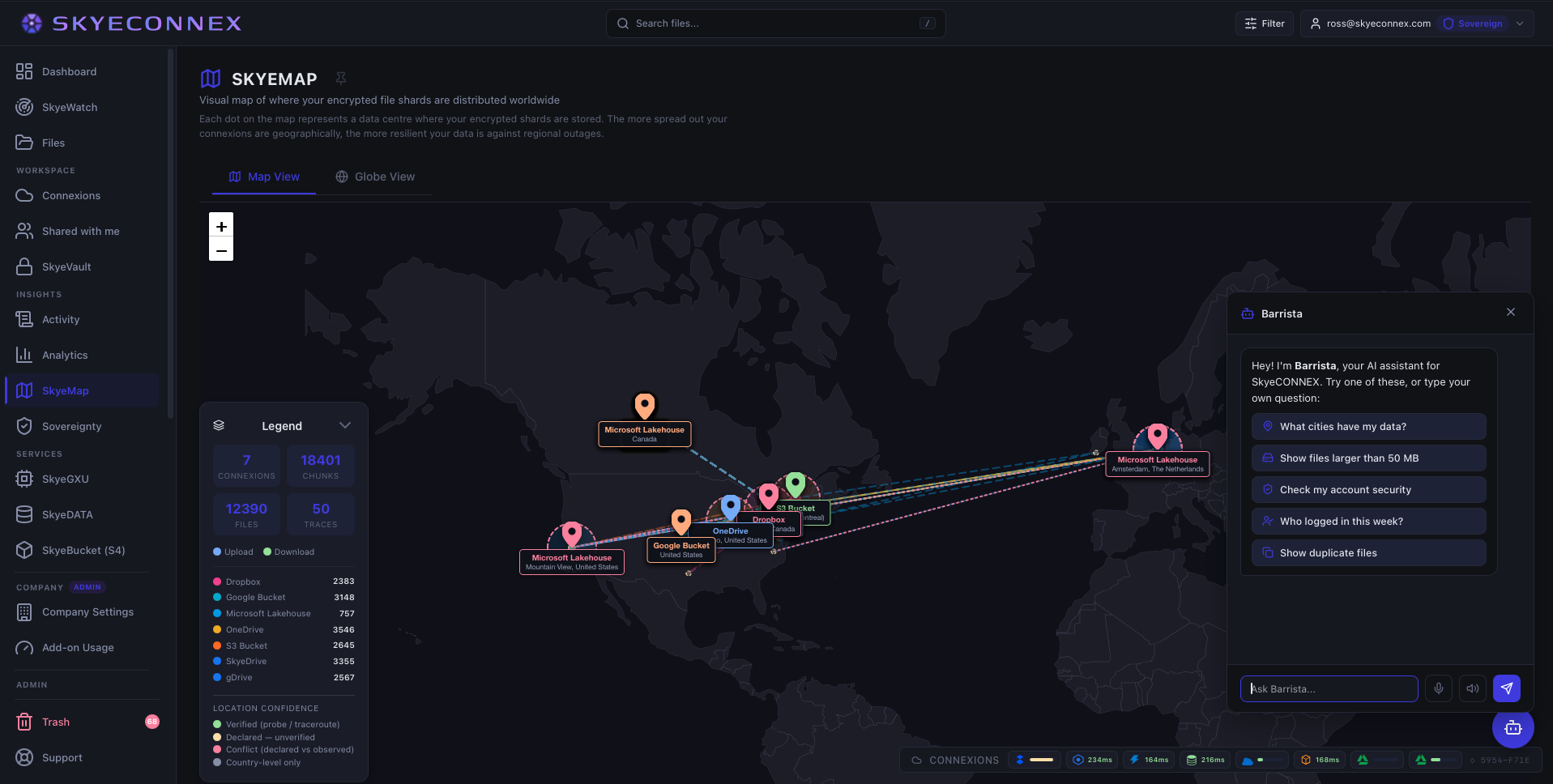
Real-time sovereignty visualisation. Account, folder, and per-file shard geography with confidence-graded endpoint pins — probed, declared, observed, country-only — so evidence and claims are visually distinct.

Learn more

Threat Simulator

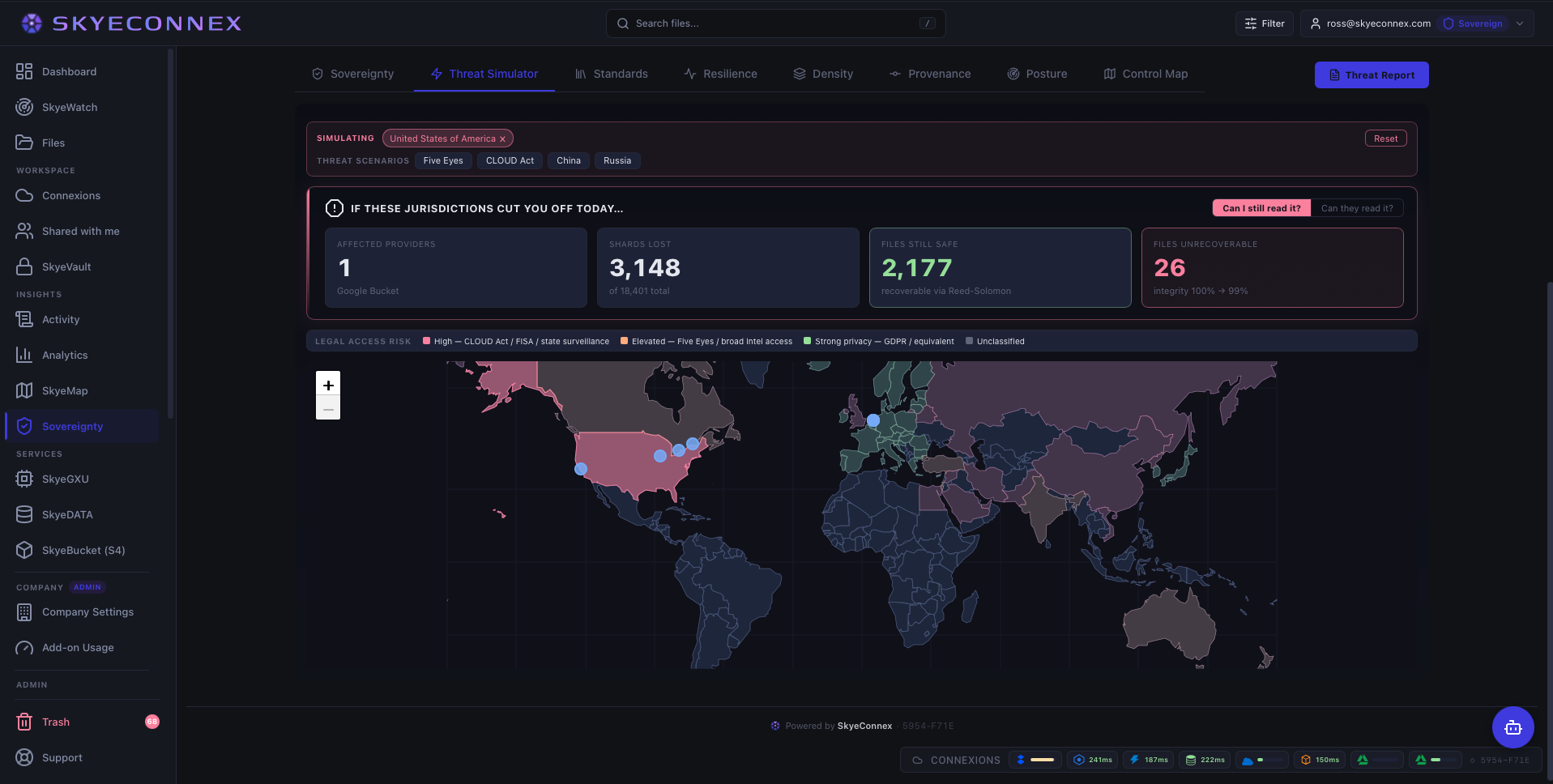
Click-to-block any country and recompute shards lost, files at risk, files unrecoverable, and the sovereignty-score delta in real time. RS(5,2)-aware. Five Eyes, CLOUD Act bloc, China, Russia — preset scenarios.

Learn more

SkyeFlow

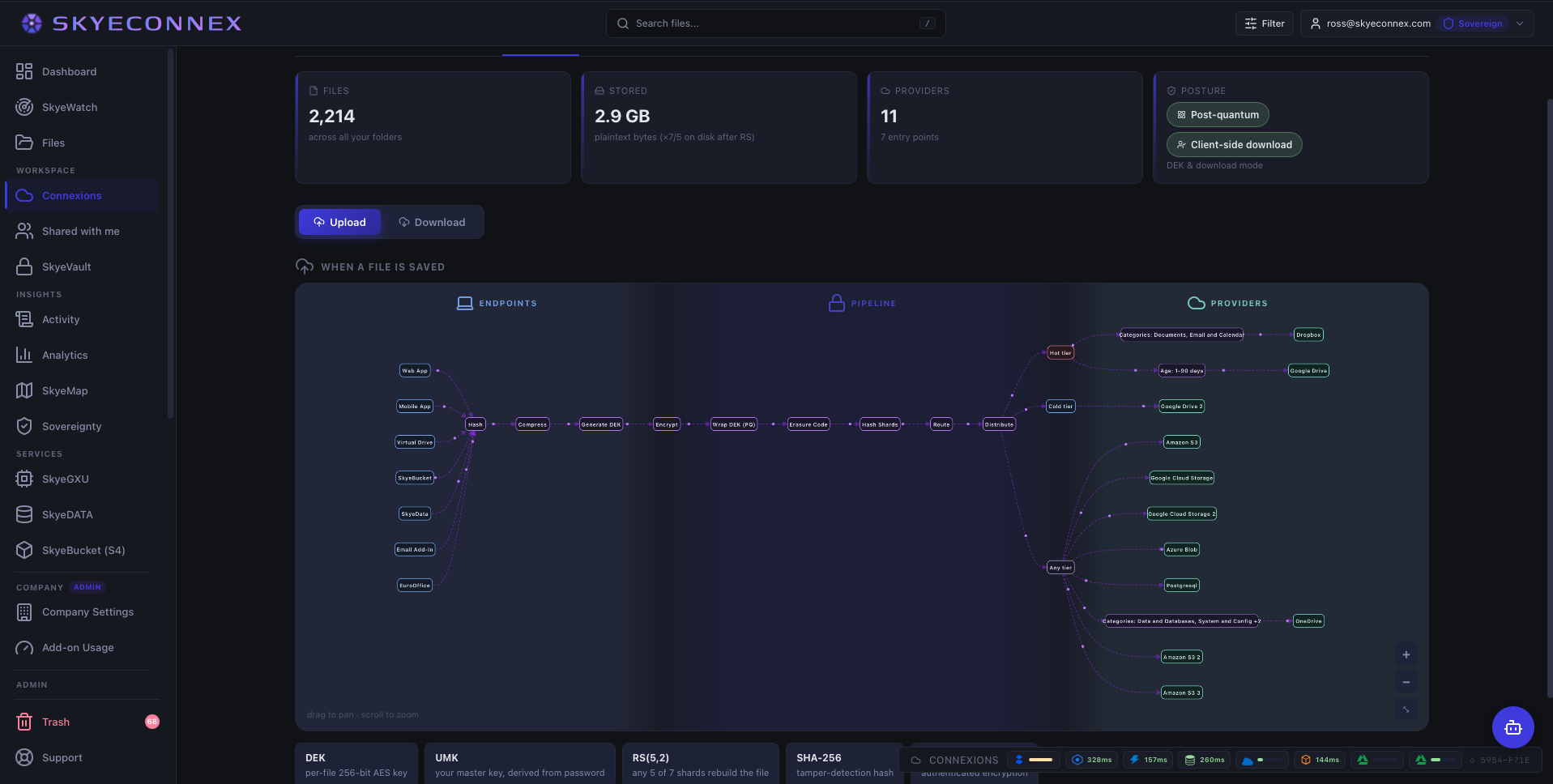
Customer-facing data-flow visualisation. Every encryption, sharding, and scatter operation rendered as a topology you can show your auditor — live from connexion state, not a slide.

Learn more

SkyeVault & SkyeDATA

Encrypted secret storage (passwords, API keys, notes) plus scheduled encrypted backup that targets the same multi-cloud RAID substrate. Veeam, AWS Backup, and Bacula retargetable at SkyeBucket.

Analyst validation

The category-defining paper named us the operational reference.

On 6 May 2026, BARC — the leading European analyst firm in data and analytics, with 25+ years of independent research — published the second edition of its global sovereignty study. We were briefed in parallel. Their position after the demonstration was unambiguous.

BARC 2026 n=320 enterprises Briefed May 2026 SCC TC · DGSI 100-8 Gartner · briefed
BARC Analysts · Post-briefing · May 2026
"This is the first and only operational implementation we have seen of what our research describes. The market knows it needs sovereignty; the implementation gap has been widening every year. SkyeConnex is the gap-closer."
51%
Rate sovereignty "very important" — up from 42% in 2025
76%
Expect strategic importance to keep rising
54%
Cite US political risk as a sovereignty driver, +8 YoY
43%
Cite technical hurdles as the top obstacle — up from 26%

Source: BARC, Data Sovereignty 2026: Reality, Relevance, Roadmap, May 2026.

Cryptographic posture

Standards-grade by construction.

Every primitive in active use is published by NIST. There are no proprietary algorithms anywhere in the platform — a deliberate choice that compresses the FIPS 140-3, Common Criteria, and FedRAMP certification path from years to months.

AES-256-GCM
FIPS 197 + SP 800-38D
Frame encryption
ML-KEM-1024
FIPS 203 · Aug 2024
Hybrid post-quantum key wrap
ML-DSA-87
FIPS 204 · Aug 2024
Post-quantum report signatures
AES Key Wrap
SP 800-38F · RFC 3394
DEK and UMK wrapping
SHA-256
FIPS 180-4
Integrity, provenance chain
HKDF-SHA-256
SP 800-56C Rev 2
Hybrid combiner
Where it lands

Built for the buyers who can't accept "trust us."

Government, defence, healthcare, financial services, legal, research. Wherever data residency, compelled-disclosure resistance, and post-quantum protection are board-level concerns.

Get in touch

Sovereignty is no longer a slide deck.

Book a briefing. We will walk you through CloudRAID, the SkyeMap, the Threat Simulator, and a signed-report verification — live, on your own data, in 45 minutes.